

Close-up Telephoto Photography

Imagine the following scenario. You're out on a hike and you see someone just down the trail taking pictures with a super zoom camera. You know it's a super zoom camera because of the long extended lens. Naturally, you look far out into the distance to see what has caught the person's eye. But you're perplexed when you see that there's nothing out there interesting enough to be the subject of a photo. You realize that you must not be able to see what has captured the photographer's attention from where you're standing, so you walk closer to the now mysterious photographer and look again. Nope, there's still nothing to see way out there in the distance.
What the heck is this person doing? Clearly, the person behind the super zoom camera is crazy, but now you desperately need to know what's going on, so you walk up to the deranged photographer and, ask him what the heck he is pointing his camera at? To your surprise, the photographer points to a spot about 30 feet away! Following the direction of his pointed finger, you scan an area of decidedly uninteresting bushes... and you spot a little orange dot on one of the bushes. What is that?
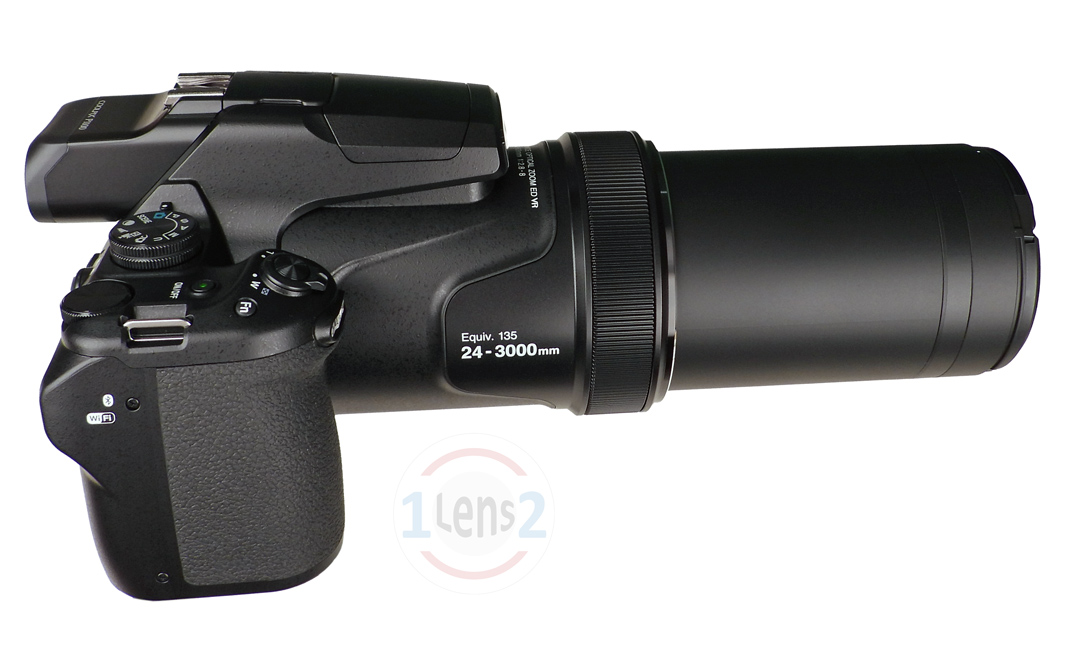 The Nikon COOLPIX P1100 super zoom camera
Sensing your confusion, the photographer waves you over to the external monitor on the super zoom camera where you see a big, beautiful orange dragonfly that fills the monitor screen! What the heck? You thought that you'd have to be an arm's length away from that dragonfly to get such a super close-up shot!

The meaning of this little parable is that a super zoom camera is a powerful tool for capturing amazing tight shots of small subjects that are close, but not close enough that you can use a "regular" non-telephoto lens. I wanted to write an article about this because when some people pick up a camera with a long lens, they can only see subjects that are really far away, even when there are some great subjects much closer. There's an old saying: "when all you have is a hammer, everything looks like a nail".
Sure, a regular lens will work just fine when you can walk right up to the subject. But sometimes you can't do that. For example, you might see a rare flower on the other side of a creek that you cannot cross. Or you might not be allowed to get close to your intended subject. The picture below shows some red fruit growing on a prickly pear cactus at a nature park in the southwest desert region of the United States. People are not allowed to walk outside of the trail, so I couldn't get any closer to the cactus.

But with a super zoom camera, or a camera with a long telephoto lens, we can still get a super close-up shot of that fruit on the cactus while staying on the trail. The 24mm picture above and the 2200mm picture below were taken at the exact same spot.

Or you might spot an animal like a rabbit or a squirrel that is close by, but not close enough to fill the frame at a short focal length. If you tried to get closer to the animal, it would probably scurry away and you'd miss the shot. And do you really want to approach a bear or a moose in the wild to get your shot? If so, then be sure to call the paramedics in advance so they are close by :)
One day I was in a marshy area near a lake taking pictures of some water fowl. I was quietly waiting for the right shot so I wasn't moving very much. I turned my head to the right and saw that a red eared pond slider turtle had emerged from the reeds!
 (this is a video frame capture)
Pictures at 100mm and 200mm didn't produce very good images of the turtle. But if I had tried to move closer, then the turtle surely would have retreated into its shell. So I stayed where I was and zoomed in to 1400mm to get the shot below:

And then I got an even better picture of the turtle at 2600mm:

Now might be a good time to explain how I was able to take a picture at a focal length of 2600mm (35mm equivalent). I shoot with the Nikon COOLPIX P1100 super zoom camera which has an optical zoom range that starts at 24mm and goes up to 3000mm. Before I switched to the P1100, I shot with the Nikon P1000, which has the same focal length range. I used those two cameras to take the pictures in this article.
Why didn't I zoom into a focal length of 3000mm when taking pictures of the turtle? Well, according to the P1100's technical specifications, the minimum distance that the P1100's autofocus system can get a lock on a subject while at a focal length of 3000mm is 23 feet (7 meters). The turtle was (apparently) less than 23 feet from the end of the camera lens, so I had to reduce the focal length to 2600mm so that the camera's auto-focus system could get a focus lock. By the way, I have since experimented with the P1100 and found that manual focus mode can get focus on a subject that's about 22 feet (6.7 meters) away.
 The Nikon COOLPIX P1100 super zoom camera
The dragonfly below is another example of a subject that would have fled the scene if I tried to get closer. I think it's either a female Blue Dasher dragonfly or a young male Blue Dasher dragonfly because it turns out that female and young male Blue Dashers are not blue!

That's a full-size picture (4608x3456 pixels), so we can crop it a little to get an even closer view of a blue dragonfly that's not blue.
 Cropped version of the Female Blue Dasher.
If I had tried to take this picture using a camera that had a lens with shorter focal length, then I would have had to walk up close to the dragonfly. And if I did that, then the dragonfly would have almost certainly flown away. So being able to take close-up pictures of dragonflies from well over twenty feet away means that I can get more great shots. More importantly, staying far away from dragonflies - and all types of creatures - means that I won't disturb them or make them uncomfortable with my presence. They can just do their thing like I wasn't there and I get pictures of their natural behavior. It's a win-win!
Close-up photography with a long lens is also common in birding. I've found that it's pretty darn rare for a bird to land right in front of you and pose for a close-up picture :) And no matter how close you can actually get to a bird, a picture taken with a lens under 300mm or so often looks like you weren't close enough.
Most of my bird pictures are at a focal length of 1000mm or higher. Actually, it's often over 2000mm... because I can with my Nikon P1100! So if you want to get a great close-up picture of a Costas Hummingbird's butt, then shoot at a focal length over 2500mm :)

Close-up telephoto photography is especially helpful when you're photographing creatures that could be dangerous if you get too close to them. This picture of a swarm of honey bees under the eve of a building is a good example. The pest control guy explained to me that the bees were swarming to protect the queen as the colony moved to a new location. The bees were so agitated that they were practically vibrating as they huddled around the queen which is somewhere in that pile of bees. It's not a very good picture, but it is a good example of how a telephoto lens can keep you safe.
 A good example of close-up telephoto photography!
There are some other benefits to taking close-up pictures at telephoto focal lengths. If you're really close to your subject, then you, your camera, the lens, or some other camera gear could easily cast a shadow on your subject. The further away you are from your subject, the less likely it is that those shadows will reach your subject.

In the picture above, I'm far enough away so that my shadow doesn't reach the rabbit, but I don't get a very good picture of the rabbit at a focal length of 24mm. As can be seen in the picture below, I can use my super zoom camera to get a nice close-up picture of the rabbit without moving from that spot.

Another benefit of close-up telephoto photography is that the field of focus is narrower at higher focal lengths. This means that the background of your image is usually noticeably out of focus which helps to visually separate your subject and prevents other visual elements in the frame from competing for the viewer's attention.

So the next time you pick-up a super zoom camera or a camera with a telephoto lens, look for great far away shots, but don't forget to look for the close-up telephoto shot. An amazing picture might be thirty feet in front of you!

Other Articles You Might Like
- Reducing Camera Shake - Tripod Legs
- An Introduction to Camera Shake
- P1100 Super Zoom Variety Episode 2
- The P1100 Super Zoom Variety Series Begins!
- P1000 Super Zoom Variety Episode 5
- Low Flying Planes Near LAX
- Zooming in on Dragonflies
- Seal Beach Pier Cargo Ships
- 50X Zooming for Photos with the FinePix S9400W
 John Miller
is the owner of "One Lens Two" and "In and Around Phoenix". He is also a co-owner of "Fooding Around Phoenix". John is always looking for collaboration opportunities so contact him using one of the options below!
John Miller
is the owner of "One Lens Two" and "In and Around Phoenix". He is also a co-owner of "Fooding Around Phoenix". John is always looking for collaboration opportunities so contact him using one of the options below! 